With the adaptation of the K-12 program, learners are expected to graduate at an age that is a bit older. This would be beneficial to the young adults venturing out into the professional world since they would be much more prepared to deal with the higher level of learning as they join college. With this, they can opt to continue their education to higher forms, which will be another great journey to access crucial learning developments.
SKILL COMPETENCY IN THE INTERNATIONAL JOB MARKET
The K-12 education system aims to improve further United States students’ mathematics, science, and social studies skills to exhibit competence in the global job market further. With K-12, the Department of Education promises to provide a higher quality education through the strands. Every track will give the learners adequate time to master a field and enhance their respective industry skills. By the end of the curriculum, K-12 graduates will be ready to become globally competitive and are set to get a spot in the meticulous labor market.
READINESS TO JOIN EMPLOYMENT
K-12 can make learners more prepared to join the workforce. K-12 has this advantage because they compel each learner to be enthusiastic about the workforce, and the scheme empowers learners to choose their own. They might or might not pursue a college program, particularly if they have chosen a track other than the academic track. Senior high school learners need not fret if they would like to explore other fields apart from their own since they get to choose electives that can also improve their skills in certain areas that they are interested in.
For 12 years, on the day before school started I would stand in front of 77 teachers and support staff and go through the drudgery of the start-of-school-year information. As principal, I had to make sure everyone knew about policy changes, lunch prices, schedules, supplies, student counts for the first ten days of school, bookkeeping updates, teacher expectations, confidentiality, and on and on. The list was exhausting—for me and for them. And though it was essential information, it wasn’t the message I wanted to share with teachers as they started a new year of shaping young minds.
What I really want teachers to hear as they start the new school year is that you don’t have to do everything all at once. Too often, teachers spend only the first day or week establishing classroom routines and expectations, and become frustrated when students still don’t seem to get it a month later. However, if you take the first four weeks to implement these three simple tips, you’ll ensure success for both yourself and your students for the rest of the year.
Simplify Your Expectations
Well-meaning teachers often make an exhaustive list of rules and expectations for students to follow. After all, they want to make sure students know what’s expected of them to alleviate the need for guesswork. In addition, many teachers involve students with developing this list, therefore giving the students ownership of their classroom environment.
Although the intent is good, I’ve found that these lists have too many rules to remember and reinforce. As a result, the lists go unnoticed after the first few days of school. Instead, I recommend the same advice a wise teacher told me more than 30 years ago when I first started teaching. Ms. Henry told me a classroom needs only two rules: Be responsible and be kind.
“Be responsible” covers everything. Think about it: Raising your hand means you are being responsible by not disrupting classroom order. Completing your work is being responsible. Taking turns, putting supplies away, listening to directions, being prepared for class—all of these are ways students can demonstrate responsibility.
Starting on day one, talk explicitly about being responsible and model what responsibility looks and sounds like. Every time you see a student doing something responsible, compliment the student and label what you saw him or her do. For example, “Thank you, Mason, for finishing your work and placing it in the basket on my desk. I appreciate you being responsible.” By naming the action, you are communicating to the rest of the class what responsibility is.
During the first four weeks of school, try to do this as frequently as possible, with a hyper focus on the behaviors you want to see for the entire school year. With every expectation you give, tie it to being responsible. The more you recognize it, name it, and reinforce it, the more students will practice being responsible until it becomes a habit.
Bring Kindness to Your Classroom
Being kind is the second rule Ms. Henry taught me. We need to be extra vigilant in teaching students what being kind actually means. Even with the youngest students, you can discuss what being kind looks like, such as how to include everyone in the room, how to resolve a conflict with a peer, how to be helpful to one another, and what being a good friend means.
Every student who steps into your room wants to belong, even if his or her behavior may indicate otherwise. That’s why it’s so important to teach and model kindness. Make sure to teach students how to include and accept students who may look or act differently. Compassion, understanding, and tolerance are some of the most valuable skills we can impart to our students.
If you spend the first few weeks of school insisting on kindness and continually teaching it through examples, you will set the right tone for the rest of the year. In addition, demonstrating kindness yourself will help build trust and lay the foundation for strong relationships with your students. And with trust, students will know that you care about them and will work harder to please you. In turn, they will be more likely to replicate that kindness to peers.
Space Out New Routines
Don’t just take a couple of days to instill routines; take a full month. So many teachers introduce all their routines on the first day or two of school, and then become frustrated when they have to repeat themselves constantly the rest of the year. You’ll find greater success in students learning and demonstrating routines if you introduce only a couple each day. And then practice, practice, practice!
On the first day of school, you might focus on what students need to do when they first walk into the classroom (e.g., how to take their seats and be prepared to listen for directions). Elementary students enter the classroom multiple times during the day (at arrival and after lunch, recess, special areas, etc.), so you’ll have several opportunities to practice. For middle and high school, you might take a few moments every day for the first few weeks to remind students how to enter the room, where to put backpacks, and what the expectations are for mobile devices.
Introducing one or two routines a day allows students to internalize and practice each routine to proficiency. Then, as you add more routines, students will continually practice what they already know as they integrate new information. Make sure to observe students as they go about routines so you can reteach, immediately, when they do not meet expectations.
Be consistent and unrelenting in reiterating what the routines are. If students practice enough, they will internalize the expectations and follow routines regularly—without you having to repeat yourself until next summer!
Final Thoughts
I know you’ll be anxious to start teaching content at the start of school—after all, that is your job! But I promise, if you take your time establishing expectations, nurturing kindness, and practicing routines in the first four weeks, you’ll be able to devote the rest of your year to the knowledge and skills you want to pass on to your students, not on behaviors that interfere with learning.
In this post, we’ll cover: calculating instructional spending and cost-effectiveness, tracking instructional allocations across locations, strategic alignment, and financial behavior.
For instructional leadership in school districts, measuring and improving student achievement and connecting instructional programs to student outcomes is key.To accomplish this goal, there are four ways to measure success.
Calculating Instructional Spending and Cost-Effectiveness
Tracking Instructional Allocations Across Locations
Aligning Spending to District Strategic Plans
Supporting Financial Literacy and Acumen
1. Calculating Instructional Spending and Cost-Effectiveness
Should a particular program be continued, expanded, reduced, or discontinued? With a clear understanding of the balance between a program’s cost and its effects, a Chief Academic Officer (CAO) and Instructional Leadership will have the right information to make these tough decisions.
In that light, ESSA is a CAO’s best friend. The federal ESSA legislation is interested in the effectiveness of every dollar. This law includes provisions to implement programs with “strong,” “moderate,” or “promising” evidence of positive outcomes for students, as determined by existing scholarly research. Thus, it will be more important than ever for a CAO to understand which programs are being implemented and to continuously monitor their results against their costs.
Specific questions that instructional leadership should ask regarding this point are:
Are we spending money on software, curriculum, training, or other materials that are well-researched and/or proven to get results?
Are these programs cost-effective relative to other programs?
2. Instructional Resource Allocation Across Schools
All students deserve equitable resources and an equal opportunity for a great education. Do you know which instructional resources are being purchased to support instructional goals? How are instructional resources selected? Can your district account for where instructional resources end up and who they serve?
A specific question that instructional leadership should ask regarding this point is:
Are instructional resources being equitably distributed across schools, according to student and school needs?
3. Strategic Alignment
For CAOs and Instructional Program Managers, teacher and student success is the bottom line. That means instructional resources must be aligned with district goals for student achievement.
Specific questions that instructional leadership should ask regarding this point are:
Are you able to track resource alignment across schools?
Can you evaluate which resources are most effective for improving student performance?
In one district, we are working on strategic plans for each instructional program that aligns to the system vision. This approach parallels a school improvement plan that a principal creates for their school. With this model, each instructional program will collect data and milestones to measure progress. One key component of this process is aligning and evaluating spending based on their program’s strategic plan.
Specific questions that instructional leadership should ask regarding this point are:
Are instructional program budgets aligned to address academic goals for the district?
What percentage of instructional budget was spent on resources to address the academic goals and priorities for the district?
4. Financial Behavior
Academic program leaders often manage large budgets. Unless they majored in accounting in college, they may not feel ready for the responsibility of managing millions of dollars. Access and control of fiscal decisions should match the level of financial responsibility that is placed on department leaders. Having readily available account information (budget, expenditures, encumbrances, and available) is vital for department-level decision making.
Specific questions that instructional leadership should ask regarding this point are:
Does instructional program leadership understand financial management?
Do instructional program managers have easy access to their financial transactions and account status?
How does your district prepare instructional program managers and principals to budget and manage money allocated for their programs?
Conclusion
The work of a Chief Academic Officer and their team of instructional leaders is central to the success of a school district. The mission of their work is to support and improve teaching and learning. The selection of curriculum materials and resources, planned professional learning, and implementation of instructional programs are keys to long-term student and district success. By ensuring they can answer the preceding questions, CAOs will ensure their districts are best serving the needs of their students.
There is undeniably a challenge that learners face as more young learners drop out of high school without graduating. As parents, instructors, employers, or even learners, it is very significant to understand what an education can do for an individual. Continue reading to learn more about the advantages of K12 education to students.
ADVANTAGES OF K-12 TO THE U.S. EDUCATION SECTOR
PREPARES STUDENTS FOR TERTIARY LEARNING
With the adaptation of the K-12 program, learners are expected to graduate at an age that is a bit older. This would be beneficial to the young adults venturing out into the professional world since they would be much more prepared to deal with the higher level of learning as they join college. With this, they can opt to continue their education to higher forms, which will be another great journey to access crucial learning developments.
READINESS TO JOIN EMPLOYMENT
K-12 can make learners more prepared to join the workforce. K-12 has this advantage because they compel each learner to be enthusiastic about the workforce, and the scheme empowers learners to choose their own. They might or might not pursue a college program, particularly if they have chosen a track other than the academic track. Senior high school learners need not fret if they would like to explore other fields apart from their own since they get to choose electives that can also improve their skills in certain areas that they are interested in.
SKILL COMPETENCY IN THE INTERNATIONAL JOB MARKET
The K-12 education system aims to improve further United States students’ mathematics, science, and social studies skills to exhibit competence in the global job market further. With K-12, the Department of Education promises to provide a higher quality education through the strands. Every track will give the learners adequate time to master a field and enhance their respective industry skills. By the end of the curriculum, K-12 graduates will be ready to become globally competitive and are set to get a spot in the meticulous labor market.
K-12 IS A LEARNER-CENTERED CURRICULUM
K-12 as a learner-centered curriculum can influence the learners to take a more active role in the learning process. With the flexibility and freedom to choose what they will learn, how they will learn, and how they can assess their own learning, this would be a way to train them regarding independence and how to be a reliable team member. Not only will this make learning very interesting and easier for learners, but it will also assist in addressing diverse needs, which comprise special cases and those that come from indigenous populations, which make the K-12 education system very inclusive for every individual.
K-12 FOSTERS GAINFUL ENTREPRENEURSHIP AND EMPLOYMENT
K-12 offers more chances for employment and entrepreneurship. Graduates of a K-12 education system can instantly get employment after they receive their certificates and pass competency-based assessments. Conversely, they can set up their own business or further their education in college. All the choices will help every learner improve their professional, skills, and competence characteristics.
THE ROLE OF K-12 TO LEARNERS AND THEIR PARENTS
It’s a sad reality that there are learners who drop out of high school without graduating, leaving them unemployed and at risk of facing difficulties. Students, employers, educators, and parents themselves hold the responsibility of ensuring that this doesn’t happen and that they secure a future for themselves. K-12 plays a vital role for learners and their parents in ensuring that they would be competitive in the workforce and hence generates progressiveness for the whole family in this economy.
LEARN HOW TO SOCIALIZE
It is a given that learning institutions are major agents of socialization. One of the things that young persons who drop out of school can miss out on is being a part of a team with peers who understand and help them. Not to mention that teachers also function as role models and a figure of authority that can keep the behavior and attitude of learners in check. With K-12, they recognize that this is a primary function of studying, and they offer more avenues for learners to socialize. Without the school’s positive influence, an individual can find himself in difficult situations during their socialization process. Social skills are required in a work environment and, basically, in making sure that you have the proper disposition to go through life. Going to school is a crucial part of this process; this is what K-12 aims to foster in the curriculum.
TEACHES RESPECT
School teaches learners to recognize authority figures not out of fear but out of respect. This values the discipline that a learner nurtures, and this will come in handy when they ultimately have authority figures in their future employment. A learner who knows how to respect coaches and school personnel will easily adapt to places of work and in other social aspects of adult life. Knowing respect and discipline by heart is crucial in becoming successful as working adults or even when planning to form a healthy household.
MASTER BASIC SKILLS
Basic skills like writing and reading are the main advantages of K-12 education. Adults who don’t master these skills usually go through a process of learning how to write and read prior to landing a good job, making the situation even more difficult for them. Acquiring basic math skills is also another advantage of a good education—math skills can help people balance their budget, search for the best prices in the market, figure out the best-paying jobs, or how to file taxes correctly. Having a good grasp of these skills all boils down to getting a solid education and having a strong foundation.
OBTAIN GENERAL KNOWLEDGE
Learning general knowledge is one of the benefits that you can get from education. The knowledge of literature, science, geography, and history can be exhilarating, and it can greatly enrich one’s life. All that crucial information can have more value than material things since someone who learns can perhaps feel more fulfilled. Additionally, this will keep them in the course of their lives with the constant eagerness to learn new things, which will assist in the person’s progress towards growth. Someone who doesn’t acquire a desire for learning will miss out on discovering the richness of other cultures and lifestyles.
K-12 OFFERS OPTIONS
Getting a K-12 education can open new doors and increase the opportunity of getting a stable job. Learners can get the opportunity to build a network, acquire more skills, and find the career that they certainly love. K-12 can get learners to access all these great opportunities and have fulfillment during this learning experience. Acquiring a K-12 diploma will make students more likely to be hired since employers usually assume that someone who completed the K-12 curriculum has the basic skills necessary for the job, have enough communication skills, can get along with the rest of the group, and follow objectives like they are supposed to.
Lastly, the many benefits of K to 12 education include basic skills like reading, counting, writing, communicating, and interacting with others. Getting this form of education not only helps your chances of landing a respectable job—but also assist you in developing the life skills you will require on your journey towards growth. Having a good education, adapting to the workplace, finding a good career, raising a family, and becoming a stable adult; that sounds like the dream, right? School might be overlooked, but its benefit is unparalleled. As parents or instructors, their roles are just as vital as the learning process that learners get from a classroom; their role is to help the young individuals understand the importance of their school lifestyle.
This is why you ought to get the most reliable educational institution that not only provides your teens the highest quality of education but equips them with the values which are crucial for making it in the real world also.
The K-12 education system has witnessed immense development, especially since the COVID-19 pandemic. As a result, the approach to teaching has become more personalized and learner-centric, and the technologies used to enhance the educational experience have taken several leaps forward.
These factors have created an education system highly beneficial for students and teachers alike while making the K-12 curriculum more comprehensive with every passing year.
This guide will dive into the five key benefits the K-12 education system offers in the 21st century.
5 Major Benefits of K-12 Education
While the advances in K-12 education offer several benefits, some particularly stand out in making this an effective system of education –
1. Builds a Strong Foundation
The K-12 system strengthens students’ foundation in crucial subjects and skills, including math, science, language, and social sciences. K-12 education also helps students master basic skills like reading and writing, which are crucial in attaining higher education and the job market.
Apart from academic and professional skills, K-12 education motivates students to become independent. Math, for instance, isn’t restricted to textbooks and theory; having a strong foundation in the subject can help students create effective budgets, manage their taxes, and make the right investments.
Mastering the basics is required to progress in any subject and build a strong foundation. With new education technologies, teachers can help students practice the necessary skills according to their individual needs so that no student gets left behind.
2. Makes High-Quality Education Accessible to All
Another crucial benefit of advances in K-12 education is that it makes education more accessible. Students often face various financial, logistical, or health-related constraints that prevent them from accessing the classroom. Since the pandemic, the K-12 system has ensured that students all over the US can access good-quality education.
Alongside several curriculum developments, students with disabilities can now access screen reader-friendly E-learning websites to make the most of their K-12 education. While this field requires more attention and action, with E-learning going online, you’ll be surprised to know that the market for the K-12 education sector is set to grow to $60.03 billion by 2023.
With such immense growth, there will be a far greater emphasis on ensuring that education is made more accessible and that investments in the education sector grow significantly.
3. Helps Master Social Skills
K-12 education is significant for social development. By interacting with each other socially, students develop strong collaboration and communication skills that will help them in the future.
Students also engage with each other intellectually and can network to create space for themselves in an increasingly competitive job market. Interacting with other students and teachers also helps younger students discover role models to look up to and learn from.
Greater access to the internet has increased connectivity and the opportunity to network with those around you. Not being able to communicate your needs or strengths with others can lead to difficulties in your career and higher education settings, reinforcing the need for strong social skills.
Innovative K-12 curricula have been able to foster collaboration. For example, a new form of learning known as three-dimensional classes tasks students to collaborate on building models or completing puzzles. To succeed, students must combine their strengths and learnings and work together to find a solution.
4. Helps Become Technologically Proficient
The increased penetration of technology in our day-to-day lives and its role in the professional sphere make it crucial that students finish their K-12 education with the ability to adapt to new technologies.
Technology offers access to information and knowledge and presents the opportunity to learn new skills. For instance, the news industry has seen several changes over the years. Earlier, one could get away with being a good writer while being accompanied by a camera person to handle the videography. However, today, graduates entering the industry are expected to be able to write, speak well, record their piece-to-cameras, and edit them.
K-12 education is already making progress in preparing its students for the future. For example, 58% of participants in a survey confessed that they feel more confident about technology in education and online tools than ever before.
5. Prepares Students for A Competitive International Job Market
Lastly, a good education in the K-12 system prepares students for a competitive job market. The skills that one learns, along with the focus on creativity, innovation, and free-thinking, make for students who can offer something of value wherever they go, with the acumen to succeed at something new.
Furthermore, the diverse student body aids students in learning to interact better with people from all walks of life, further strengthening the much-needed collaborative skills employers look for these days.
High school graduates of the K-12 system are also equipped to learn new skills and pick up new concepts should they change their career path from the electives they chose while in school. Along with the fact that an education in the K-12 system is highly recognized and opens many doors in the market, it gives students the environment they need to succeed in their professional careers.
In Conclusion
Education is more than memorizing concepts and passing examinations. A good education equips students with critical thinking, collaborative, and technological skills needed to deal with all aspects of life, from their finances and career to their social lives and personal well-being.
The benefits of an education in the K-12 system are many, as you can see from the points mentioned above. More students are expected to reap these benefits as schools and governments invest more in the system and up-to-date technologies. Here are some of the best K-12 companies investing in their students’ growth.Last month, we wrote about how newly released 2018 SBAC test score data show that student growth in math has been insufficient to keep pace with grade-level proficiency standards. And though student growth in math proficiency is accelerating, racial disparities are widening as students progress through school.
The picture is somewhat more promising for English. Growth in English test scores generally outpaced the state standards—meaning more students were gaining mastery of English than in prior years. Moreover, the growth in 2018 English scores was much higher than in 2017.
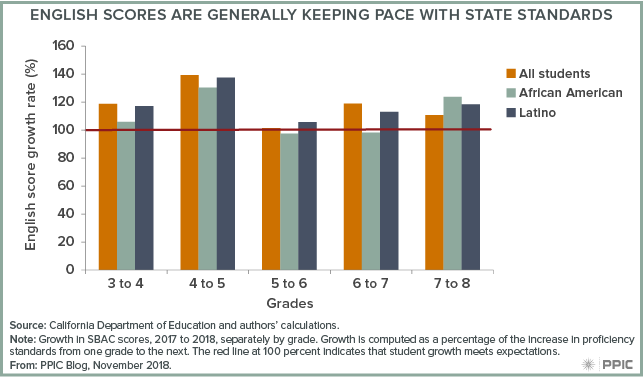
The figure below shows the growth in English test scores from grade to grade—how last year’s third graders performed in fourth grade, and so on—relative to the growth in the score required for proficiency in each grade. A growth rate of greater than 100% indicates that average student progress is outpacing what is expected by the standards, while growth of less than 100% suggests progress is not keeping pace with standards.
Across all grades, growth in average student test scores outpaced growth in grade-level proficiency standards. This year’s 5th graders showed particular improvement, with average growth outpacing the standards by 40%. In other words, many more 5th graders are meeting standards in English than they were last year in 4th grade (49.4% vs 45.1% to be exact).
But in most grades, racial disparities in English achievement are still growing with each grade progression: the scores of African American and Latino students grew less than the average student’s scores. However, the pattern is reversed in between grades 7 and 8, where African American and Latino scores grew more than average, reducing these disparities somewhat. In addition, the disparities in English score growth are notably smaller than the disparities in math.
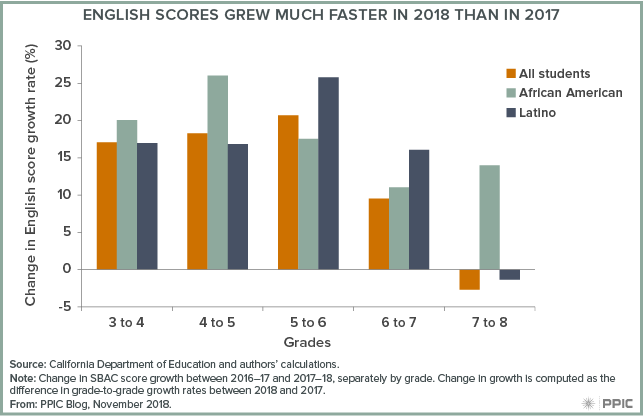
We also see improvements when we compare growth rates between 2017 and 2018. Growth in grades 4 to 7 accelerated considerably in 2018—for example, among Latino sixth graders, English test scores improved a little over 25% more than the scores of their counterparts in 2017—though growth in grade 8 was slightly slower compared to 2017. African American student progress was especially noteworthy, with growth improving more than the average student across four of five grades. While the previous figure shows that achievement gaps still grow slightly as students progress through school, these gaps in growth are small and shrinking.
Looking at the grade-to-grade growth of the same cohorts of students provides a lens to examine whether students are keeping up with grade-level expectations, and whether achievement gaps are shrinking or growing as students advance through school. These findings generate hope that recent reforms are bearing fruit, but there is yet more work to be done. Despite progress in 2018, just under half of our students in grades 3–8 and 11 are proficient at their grade level in English, and less than 40% are in math. Sustaining and improving on this growth will be key to addressing these shortcomings in student achievement.
MICHAEL KIRBY SMITH/REDUX
The United States bests almost every country in the world in many areas, but when it comes to educational achievement, American students are just plain mediocre. According to the 2012 results of the Programme for International Student Assessment (PISA) — a test of critical thinking administered every three years to about half a million 15-year-olds around the globe — U.S. students are lagging behind those in many other countries, including China, Finland and Korea, in math, reading and science.
PISA scores aren’t the only measure of an educational system, but most experts agree that American schools are in need of a major overhaul. The question is: What kinds of reforms will result in lasting, meaningful changes?
1. Invest in Training Teachers — and Their Bosses
The quality of a child’s teacher is extremely important to success. “As a nation, we haven’t invested in the training of our educators like we have in the training of our doctors and our lawyers. Even the best education program is going to produce a novice teacher,” Steve Fink, executive director of the Center for Educational Leadership at the University of Washington says.
We also need to improve the quality of our school and district leaders. At the Center for Educational Leadership, says Fink, “We work with teachers to improve their teaching, while simultaneously working with the school principals to help them learn how to support teachers, and simultaneously working with district leaders, superintendents and central office leaders to teach them how to support principals.”
2. Don’t Focus on Punishing Bad Teachers. Learn How to Make Good Ones Instead
You can’t hold people accountable for things they don’t know how to do. “Accountability only works if we actually help people learn and grow and teach them what they need to know in order to be held accountable. Instead we are doing the opposite,” says Fink. “We throw high-stakes testing at kids, and when test results are great, we give teachers more money. When they’re bad, we punish them and sanction them, and close down [schools]. … There’s literally zero research to support that any of these policies actually work.”
So what does work? That’s harder to say. “It’s not attributable to years of experience or what kind of degrees the teachers have… but identifying teachers’ individual strengths and weaknesses and trying to help them get better, is promising,” says Laura Hamilton, a senior behavioral scientist at the RAND Corporation, a federally funded think tank.
3. Modernize the Teacher’s Job
No teacher is an island. And yet in the traditional education model, each teacher works alone, isolated in his or her own classroom without adequate communication or support from the school — or from peers. This is “really a factory-style model,” says Lynette Guastaferro, executive director of Teaching Matters, a nonprofit advocacy group in New York City. Schools should identify who their best, most effective teachers are and then empower them to lead and help train other teachers. “What this does is two things,” says Guastaferro. “It helps solve the problem of [teacher] retention and it helps to reduce isolation, allowing [teachers] to problem-solve together.”
4. Think in Terms of Tradeoffs, Not Absolutes
The common wisdom is that children learn better in smaller classes than in big ones. But reducing class size is expensive — you need more teachers and classrooms. Here’s another costly measure: extending the school year. Yet we also know that over summer vacation, kids from poor families fall behind because they’re not engaged in the kinds of enriching activities that kids from affluent families are.
Few public school systems have the money to extend both the school year and shrink class size. “So I did a little thought experiment,” says Matt Chingos, a fellow in the Brown Center on Education Policy at the Brookings Institution, a Washington, D.C.-based research group. “What if we wanted to extend the school year … [and] compensated for that by making classrooms a little bigger?” What you find is that the “positive effect of spending more days in school is larger than the negative effect of having larger classes. It’s important to think about these tradeoffs,” he says.
5. Let Kids Learn at Their Own Pace
Schools have been hot to adopt all kinds of new technologies many of which have had a limited effect on student achievement, says RAND’s Laura Hamilton. But one especially promising strategy involves using adaptive learning programs to tailor instruction to each student — that is, “breaking away from the traditional classroom model where one teacher tells 25 kids to do the same things at the same time,” Hamilton says.
This allow kids to work at their own pace and set their own goals. It also lets teachers give more focused attention to smaller groups — while other groups work independently — instead of teaching the whole class at once.
6. Get Families Involved Early
A substantial amount of research suggests that early childhood education, when done well, may be key to kids’ achievement in the long-term. “Some of the programs that have been successful are those that include some sort of a family outreach component, so it’s not just getting the kids to the program for several hours a day, it’s involving the parents and other family members, so they are contributing to kids learning,” says Hamilton. “I think kids can benefit from that all the way through high school.”
7. Address the Issue of Poverty
Where you live often prescribes your destiny when it comes to public education. Which is why we end up with disproportionate numbers of poor kids in certain schools and wealthy ones in others. “I think there’s this argument in education: It’s poverty or it’s teacher quality. It’s actually both,” says Lynette Guastaferro of Teaching Matters. “At some point we have to address this issue of the concentration of poor kids, because that issue has gotten radically worse over the last 30 years. Until we solve that, we’ll only be filling the glass halfway.”
Managing school district finances effectively requires a complicated series of day-to-day, monthly, and annual tasks administered by finance officers at the district level. From creating and balancing budgets, to managing contracts, paying vendors, and maintaining assets, all functions are geared toward aligning desired student outcomes with available resources.
In many states, schools are forced to meet rising academic standards with inadequate or declining funding. Michigan schools, for example, have seen total revenues decline by 30% since 2002. Maintaining a well-performing K-12 school system that meets 21st century needs with limited resources requires effective financial management.
Challenging Times Necessitate a Systematic Approach
School finances are closely tied to both public policy and student achievement. School funding is a concern in the current climate of economic uncertainty. With per-pupil allocations and revenue-raising tax system fluctuations, it is necessary to keep pace with decisions affecting school funding. Declines in enrollment and revenue alongside aging facilities strain school districts to operate more efficiently. During these challenging economic times, effective school finance officers can leverage the following strategies to support a systematic approach.
Strategy #1: Monitor data, public policy, and legislation continuously
These include student demographic and achievement data, enrollment trends, financial reviews, state funding formulas, etc. Since district finances are closely tied to enrollment and per-pupil funding allowances, recognizing and analyzing trends allows school finance officers to make data-driven decisions, proactively create projections, and anticipate impending challenges.
Strategy #2: Create a strategic three to five year plan
By focusing on student learning outcomes, stakeholders create a three to five year strategic plan. This long-term plan is then broken down into implementation plans with actions steps that guide the budgeting process. In partnership with instructional staff, finance leaders ensure that annual budgets are carefully aligned to district goals.
Consider hidden costs, locate inefficiencies, and rethink outdated processes. By keeping administrative costs under control, districts can ensure that funds are allocated where they should be: in the classroom. Investigate the indirect and soft costs related to district operations.
Strategy #4: Manage district assets appropriately
Anticipate capital expenditures and minimize maintenance costs. By working closely with facilities administrators and staff, school finance officers can plan appropriately and in advance.
Strategy #5: Operate with transparency and accountability
Establish and maintain public trust. Tailoring communications to various groups allows school finance officers to collaborate effectively with school board members, administrators, academic leaders, and community members. Engaging these stakeholders in long-term planning increases buy-in and confidence, building support for the strategic goals.
Strategy #6: Review cost containment strategies
Take a look at cost containment relative to consolidation and contracting school support services. Even as school districts strive to improve student outcomes with rigorous standards and new technologies, it is possible to improve business practices by refining operational processes. Academic return on investment should always be a top priority.
Examining Support Services
School districts perform a wide variety of services that may include meals, transportation, and communications on top of their primary mission of instruction. In addition, there are numerous administrative duties involved in the provision of these services. To remain viable and competitive in the current market, school districts must be fiscally responsible. Contracting services where appropriate can improve quality, reduce costs, or both.
School finances support and enable the district’s educational initiatives, as instructional goals drive the budget. The strategic use of outside contractors and staffing agencies can add value to a district’s spending. Personnel costs, a dominant feature of school district budgets, are largely controlled at the local level. The staffing of substitute teaching personnel is a budgetary line item that warrants consideration.
Accessing Innovative and Cost-saving Solutions
Effective financial management means thinking outside the box and looking outside the district. Accessing specialized and innovative solutions can impact the bottom line. A staffing agency that increases fill-rate for substitute teachers promises an academic return on investment. With substitute teachers filling in for inevitable teacher absences, this budget line supports the strategic plan and helps to maintain instructional momentum. Quality substitutes trained to support the district’s instructional goals and educational initiatives add value to the school day.
A full-service K-12 educational staffing agency that manages the hiring, background checks, and credentialing of a substitute pool relieves the district’s human resource department of the time and money required. When that agency also handles the training, scheduling, and reporting functions of managing that talent pool, the savings continue to grow. Add in the soft cost savings that include insurance, administration, payroll, and documentation, and contracting substitute staffing and management from an experienced education staffing company like ESS becomes a choice that can both improve instructional quality and keep costs down.
Online Bachelor’s Degree Program Questions
Is the School Accredited?
How Long Does it Take To Complete a Bachelor’s Degree Online?
Can I Transfer Existing Credits to an Online Degree Program?
How is Course Content Delivered and When Might I Have to Meet with Instructors and Peers?
What is the Difference Between Bachelors’ Degree Awarded by a Brick-and-Mortar University and one Awarded by an Online School?
Earning an online Bachelor’s degree can be as intellectually satisfying as completing a degree in a physical University. This Bachelor’s degree can serve as the ticket to future success in the workplace or further study in a graduate program. Before enrolling in an online program, there are several key questions that the prospective student should consider.
Is the School Accredited?
Possibly the most important first step a student will take when considering enrollment in an online school is to verify its accreditation. Do not merely simply research reviews of the school online; affirm that the school is nationally or regionally accredited by an accepted governing body such as The Council for Higher Education Accreditation. While advantages and disadvantages exist with each type of accreditation, you are wasting your time and money (before taking a single test) if the school is an unaccredited diploma mill.
How Long Does it Take To Complete a Bachelor’s Degree Online?
In a traditional University, the undergraduate usually earns their degree within four years. Online colleges can offer greater flexibility by allowing students to take more credit hours or by offering accelerated programs in some courses of study. This can cut down the time it takes to earn a Bachelor’s degree by a year or more, but the student must then devote more time to their studies. Remember also that even online colleges require that undergraduates complete their online Bachelor’s degree program within a fixed period of time.
Can I Transfer Existing Credits to an Online Degree Program?
This is an important question because it might save you having to retake courses if you started your degree at a physical University. Virtually all online colleges accept existing credits provided these were earned at an accredited school. Often these credits will need to have been earned within a recent span of time to be considered valid. Moreover, most colleges will only accept only C grades or higher for transfer. A good online college will have a transfer advisor who can authoritatively answer any questions students may have prior to enrolling.
How is Course Content Delivered and When Might I Have to Meet with Instructors and Peers?
Contrary to a persistent belief, online courses are not limited to webpages, PDF documents, and video lectures. Many courses deliver content via custom-designed platforms designed to foster interactive communication between the instructor and students as if both were present in a physical classroom. Moreover, some degree programs require an in-person component in which the student is expected to meet with an instructor one or more times over the length of the course. Nursing and Health Care degrees often include such elements. Prior to enrolling, research what instruction methods your online bachelor’s degree favors.
What is the Difference Between Bachelors’ Degree Awarded by a Brick-and-Mortar University and one Awarded by an Online School ?
A Bachelor’s degree awarded by a physical University and one awarded by accredited online schools such as the University of Phoenix carry the same weight. While online schools have garnered increasing respect in the eyes of employers and graduate schools, an important caveat remains. The prospective student should thoroughly investigate the school’s degree requirements. Earning an Online Bachelor’s Degree requirements should include the amount of credit hours required, the courses needed to meet this requirement, and the order in which this course of study should occur. The school’s literature must state clearly these requirements. If degree requirements seem hazy or require payment in advance, this final degree will carry little worth.
Students now have more options than ever in pursuing an online Bachelor’s degree. Virtual universities abound and the options for study are plentiful. Ensure that you “do your homework” prior to committing to pursuing that degree.
Discover Everything You Need To Know (Good And Bad) About Online Education
One of the most oft-used terms after the pandemic is the term “new normal.” The new normal in education is the increased use of online learning tools. The COVID-19 pandemic has triggered new ways of learning. All around the world, educational institutions are looking toward online learning platforms to continue with the process of educating students. The new normal now is a transformed concept of education with online learning at the core of this transformation. Today, digital learning has emerged as a necessary resource for students and schools all over the world. For many educational institutes, this is an entirely new way of education that they have had to adopt. Online learning is now applicable not just to learn academics but it also extends to learning extracurricular activities for students as well. In recent months, the demand for online learning has risen significantly, and it will continue doing so in the future.
As with most teaching methods, online learning also has its own set of positives and negatives. Decoding and understanding these positives and negatives will help institutes in creating strategies for more efficiently delivering the lessons, ensuring an uninterrupted learning journey for students.
What Are The Advantages Of Online Learning?
1. Efficiency
Online learning offers teachers an efficient way to deliver lessons to students. Online learning has a number of tools such as videos, PDFs, podcasts, and teachers can use all these tools as part of their lesson plans. By extending the lesson plan beyond traditional textbooks to include online resources, teachers are able to become more efficient educators.
2. Accessibility Of Time And Place
Another advantage of online education is that it allows students to attend classes from any location of their choice. It also allows schools to reach out to a more extensive network of students, instead of being restricted by geographical boundaries. Additionally, online lectures can be recorded, archived, and shared for future reference. This allows students to access the learning material at a time of their comfort.
Thus, online learning offers students the accessibility of time and place in education.
3. Affordability
Another advantage of online learning is reduced financial costs. Online education is far more affordable as compared to physical learning. This is because online learning eliminates the cost points of student transportation, student meals, and most importantly, real estate. Additionally, all the course or study materials are available online, thus creating a paperless learning environment which is more affordable, while also being beneficial to the environment.
4. Improved Student Attendance
Since online classes can be taken from home or location of choice, there are fewer chances of students missing out on lessons.
5. Suits A Variety Of Learning Styles
Every student has a different learning journey and a different learning style. Some students are visual learners, while some students prefer to learn through audio. Similarly, some students thrive in the classroom, and other students are solo learners who get distracted by large groups.
The online learning system, with its range of options and resources, can be personalized in many ways. It is the best way to create a perfect learning environment suited to the needs of each student.
What Are The Disadvantages Of Online Learning?
1. Inability To Focus On Screens
For many students, one of the biggest challenges of online learning is the struggle with focusing on the screen for long periods of time. With online learning, there is also a greater chance for students to be easily distracted by social media or other sites. Therefore, it is imperative for the teachers to keep their online classes crisp, engaging, and interactive to help students stay focused on the lesson.
2. Technology Issues
Another key challenge of online classes is internet connectivity. While internet penetration has grown in leaps and bounds over the past few years, in smaller cities and towns, a consistent connection with decent speed is a problem. Without a consistent internet connection for students or teachers, there can be a lack of continuity in learning for the child. This is detrimental to the education process.
3. Sense Of Isolation
Students can learn a lot from being in the company of their peers. However, in an online class, there are minimal physical interactions between students and teachers. This often results in a sense of isolation for the students. In this situation, it is imperative that the school allow for other forms of communication between the students, peers, and teachers. This can include online messages, emails and video conferencing that will allow for face-to-face interaction and reduce the sense of isolation.
4. Teacher Training
Online learning requires teachers to have a basic understanding of using digital forms of learning. However, this is not the case always. Very often, teachers have a very basic understanding of technology. Sometimes, they don’t even have the necessary resources and tools to conducts online classes.
To combat this, it is important for schools to invest in training teachers with the latest technology updates so that they can conduct their online classes seamlessly.
5. Manage Screen Time
Many parents are concerned about the health hazards of having their children spend so many hours staring at a screen. This increase in screen time is one of the biggest concerns and disadvantages of online learning. Sometimes students also develop bad posture and other physical problems due to staying hunched in front of a screen.
A good solution to this would be to give the students plenty of breaks from the screen to refresh their mind and their body.
WordPress SEO fine-tune by Meta SEO Pack from Poradnik Webmastera
 K-12 can make learners more prepared to join the workforce. K-12 has this advantage because they compel each learner to be enthusiastic about the workforce, and the scheme empowers learners to choose their own. They might or might not pursue a college program, particularly if they have chosen a track other than the academic track. Senior high school learners need not fret if they would like to explore other fields apart from their own since they get to choose electives that can also improve their skills in certain areas that they are interested in.
 There is undeniably a challenge that learners face as more young learners drop out of high school without graduating. As parents, instructors, employers, or even learners, it is very significant to understand what an education can do for an individual. Continue reading to learn more about the advantages of K12 education to students.
 Lastly, the many benefits of K to 12 education include basic skills like reading, counting, writing, communicating, and interacting with others. Getting this form of education not only helps your chances of landing a respectable job—but also assist you in developing the life skills you will require on your journey towards growth. Having a good education, adapting to the workplace, finding a good career, raising a family, and becoming a stable adult; that sounds like the dream, right? School might be overlooked, but its benefit is unparalleled. As parents or instructors, their roles are just as vital as the learning process that learners get from a classroom; their role is to help the young individuals understand the importance of their school lifestyle.
This is why you ought to get the most reliable educational institution that not only provides your teens the highest quality of education but equips them with the values which are crucial for making it in the real world also.
Lastly, the many benefits of K to 12 education include basic skills like reading, counting, writing, communicating, and interacting with others. Getting this form of education not only helps your chances of landing a respectable job—but also assist you in developing the life skills you will require on your journey towards growth. Having a good education, adapting to the workplace, finding a good career, raising a family, and becoming a stable adult; that sounds like the dream, right? School might be overlooked, but its benefit is unparalleled. As parents or instructors, their roles are just as vital as the learning process that learners get from a classroom; their role is to help the young individuals understand the importance of their school lifestyle.
This is why you ought to get the most reliable educational institution that not only provides your teens the highest quality of education but equips them with the values which are crucial for making it in the real world also. The K-12 education system has witnessed immense development, especially since the COVID-19 pandemic. As a result, the approach to teaching has become more personalized and learner-centric, and the technologies used to enhance the educational experience have taken several leaps forward.
These factors have created an education system highly beneficial for students and teachers alike while making the K-12 curriculum more comprehensive with every passing year.
This guide will dive into the five key benefits the K-12 education system offers in the 21st century.
The K-12 education system has witnessed immense development, especially since the COVID-19 pandemic. As a result, the approach to teaching has become more personalized and learner-centric, and the technologies used to enhance the educational experience have taken several leaps forward.
These factors have created an education system highly beneficial for students and teachers alike while making the K-12 curriculum more comprehensive with every passing year.
This guide will dive into the five key benefits the K-12 education system offers in the 21st century.

 Across all grades, growth in average student test scores outpaced growth in grade-level proficiency standards. This year’s 5th graders showed particular improvement, with average growth outpacing the standards by 40%. In other words, many more 5th graders are meeting standards in English than they were last year in 4th grade (49.4% vs 45.1% to be exact).
But in most grades, racial disparities in English achievement are still growing with each grade progression: the scores of African American and Latino students grew less than the average student’s scores. However, the pattern is reversed in between grades 7 and 8, where African American and Latino scores grew more than average, reducing these disparities somewhat. In addition, the disparities in English score growth are notably smaller than the disparities in math.
We also see improvements when we compare growth rates between 2017 and 2018. Growth in grades 4 to 7 accelerated considerably in 2018—for example, among Latino sixth graders, English test scores improved a little over 25% more than the scores of their counterparts in 2017—though growth in grade 8 was slightly slower compared to 2017. African American student progress was especially noteworthy, with growth improving more than the average student across four of five grades. While the previous figure shows that achievement gaps still grow slightly as students progress through school, these gaps in growth are small and shrinking.
Across all grades, growth in average student test scores outpaced growth in grade-level proficiency standards. This year’s 5th graders showed particular improvement, with average growth outpacing the standards by 40%. In other words, many more 5th graders are meeting standards in English than they were last year in 4th grade (49.4% vs 45.1% to be exact).
But in most grades, racial disparities in English achievement are still growing with each grade progression: the scores of African American and Latino students grew less than the average student’s scores. However, the pattern is reversed in between grades 7 and 8, where African American and Latino scores grew more than average, reducing these disparities somewhat. In addition, the disparities in English score growth are notably smaller than the disparities in math.
We also see improvements when we compare growth rates between 2017 and 2018. Growth in grades 4 to 7 accelerated considerably in 2018—for example, among Latino sixth graders, English test scores improved a little over 25% more than the scores of their counterparts in 2017—though growth in grade 8 was slightly slower compared to 2017. African American student progress was especially noteworthy, with growth improving more than the average student across four of five grades. While the previous figure shows that achievement gaps still grow slightly as students progress through school, these gaps in growth are small and shrinking.
 Looking at the grade-to-grade growth of the same cohorts of students provides a lens to examine whether students are keeping up with grade-level expectations, and whether achievement gaps are shrinking or growing as students advance through school. These findings generate hope that recent reforms are bearing fruit, but there is yet more work to be done. Despite progress in 2018, just under half of our students in grades 3–8 and 11 are proficient at their grade level in English, and less than 40% are in math. Sustaining and improving on this growth will be key to addressing these shortcomings in student achievement.
 Managing school district finances effectively requires a complicated series of day-to-day, monthly, and annual tasks administered by finance officers at the district level. From creating and balancing budgets, to managing contracts, paying vendors, and maintaining assets, all functions are geared toward aligning desired student outcomes with available resources.
In many states, schools are forced to meet rising academic standards with inadequate or declining funding. Michigan schools, for example, have seen total revenues decline by 30% since 2002. Maintaining a well-performing K-12 school system that meets 21st century needs with limited resources requires effective financial management.
Managing school district finances effectively requires a complicated series of day-to-day, monthly, and annual tasks administered by finance officers at the district level. From creating and balancing budgets, to managing contracts, paying vendors, and maintaining assets, all functions are geared toward aligning desired student outcomes with available resources.
In many states, schools are forced to meet rising academic standards with inadequate or declining funding. Michigan schools, for example, have seen total revenues decline by 30% since 2002. Maintaining a well-performing K-12 school system that meets 21st century needs with limited resources requires effective financial management.